

Grab a can of Coke and take a good look at it. It seems simple enough, right? Just a metal cylinder holding some fizzy soda. But those Coke can dimensions you are holding did not happen by accident. Every millimeter got calculated, tested, and locked in decades ago — and it has not changed much since.
We will cover exact measurements, explain why they are so precise, and answer the questions people search for most.
Standard 12 fl oz Coke Can Dimensions
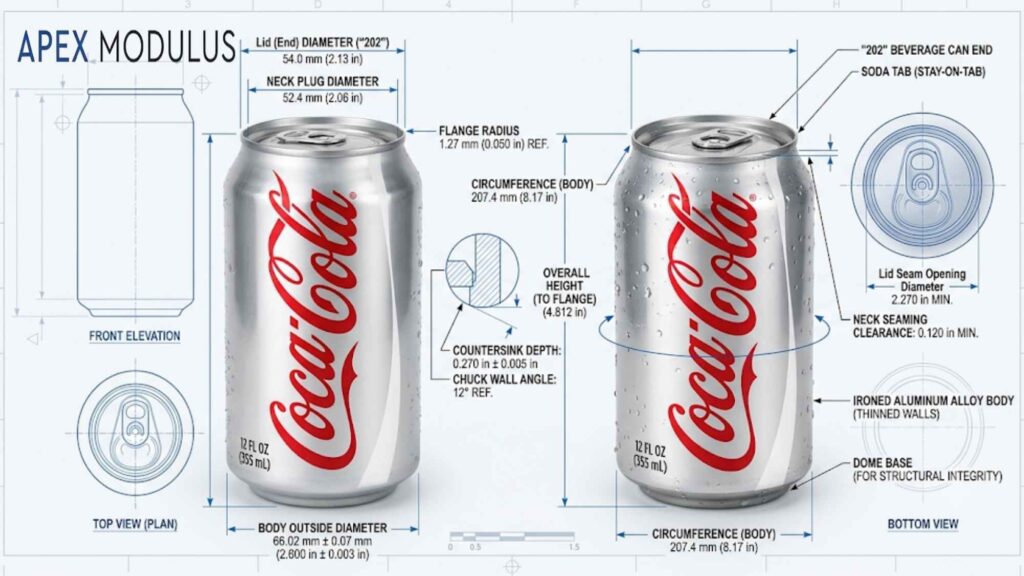
Let’s start with the one you already know. The standard 12 oz Coke can is the benchmark against which every other size gets measured — literally.
Here is the breakdown:
| Measurement | Imperial | Metric |
|---|---|---|
| Height | 4.83 inches | 122.7 mm |
| Body diameter | 2.60 inches | 66 mm |
| Lid diameter | 2.13 inches | 54 mm (a “202 end”) |
| Circumference | 8.17 inches | 207 mm |
| Volume | 12 fl oz | 355 ml |
That body diameter of 2.6 inches is not random, either. It is close to the average adult palm width, which is exactly why the can feels so natural to hold. Coca-Cola did not stumble into that — it is the result of decades of refinement dating back to when the company switched from steel to aluminum in the early 1960s.
You will also notice the can narrows toward the top. That taper drops the lid diameter down to 2.13 inches, which saves aluminum and reduces the amount of metal needed for the pressurized seal. Small design choice, big cost savings when you are producing billions of cans a year.
Explore this, How Big Is 20 cm? 15 Everyday Comparisons
Can Sizes Compared
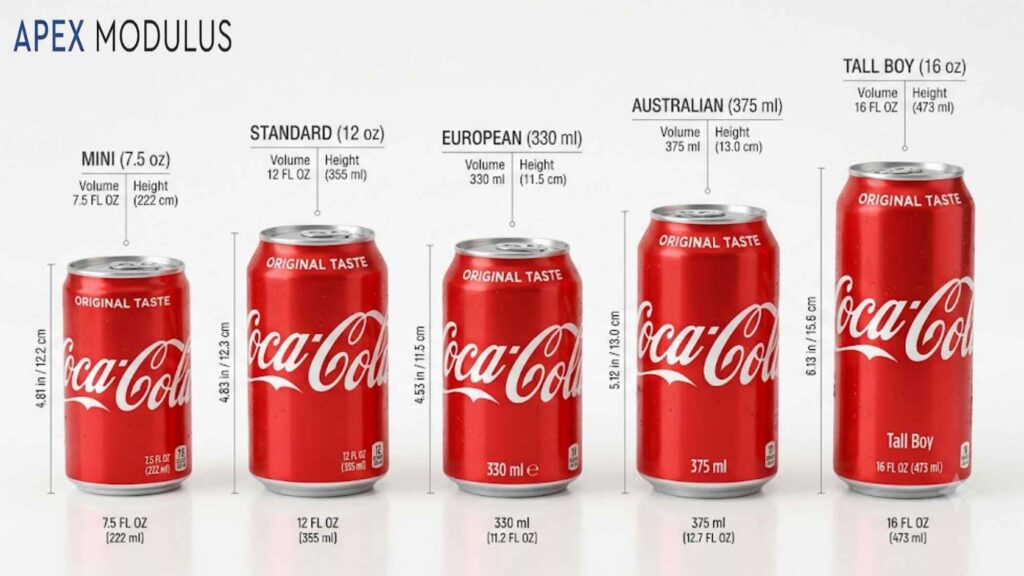
The standard can gets all the attention, but Coca-Cola actually produces a whole lineup of formats. Here is how they stack up:
| Can Type | Volume | Height | Diameter |
|---|---|---|---|
| Mini can | 7.5 oz (222 ml) | ~4.0 in | 2.60 in |
| Standard can | 12 fl oz (355 ml) | 4.83 in | 2.60 in |
| Tall boy / slim can | 16 oz (473 ml) | 6.03–6.19 in | 2.60 in |
| European standard | 330 ml (11.2 oz) | 4.75 in | 2.60 in |
| Australian standard | 375 ml (12.7 oz) | 5.11 in | 2.60 in |
Notice the pattern? The can diameter barely budges across most formats. Coca-Cola keeps that 2.6-inch width consistent almost everywhere, and only adjusts the height to hit different volumes.
That is not laziness — it is smart engineering, since it lets the same manufacturing lines, filling equipment, and vending machine coils handle nearly every beverage can dimension in the lineup.
Slim cans, sometimes used for premium or diet variants, which drop the diameter down closer to 2.1–2.3 inches for a noticeably narrower, more elegant grip.
Read this, How Long Is 5 Inches? 15 Everyday Objects
Anatomy of a Coke Can: More Than Just a Cylinder
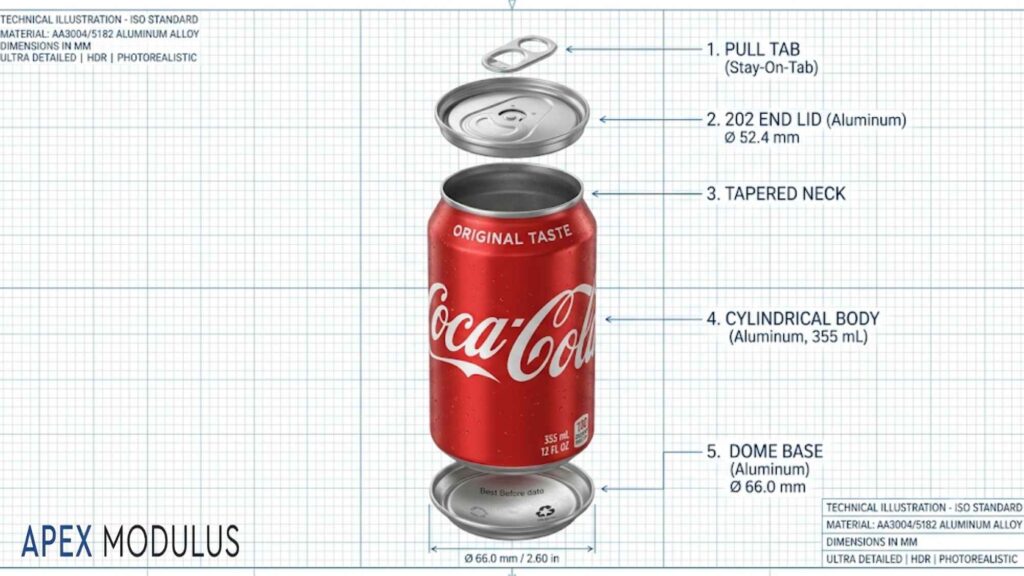
Here is something most people never think about: a Coke can is not actually a simple tube. It is a carefully engineered shape with several distinct zones.
The dome base. The bottom curves inward, not flat. That concave dome distributes internal pressure evenly and lets the can stack without buckling under its own weight on a pallet.
The body. This is the straight cylindrical section — your 2.6-inch body width — where most of the liquid sits.
The neck. Near the top, the can tapers inward through a process called “necking.” This is where the precise dimensions matter most, since even a fraction of a millimeter off can cause seaming problems on the production line.
The 202 end. That is industry shorthand for the standard lid size (2.125 inches). It is called a “202 end” because can manufacturers measure lid diameter in sixteenths of an inch — 2 and 2/16ths. You will see this exact terminology on spec sheets across the entire beverage industry, not just Coca-Cola.
Wall thickness. Here is the wild part: the aluminum walls measure roughly 0.0037 inches thick — thinner than a human hair in some spots. Yet that razor-thin wall holds over 90 PSI of internal pressure from carbonation. That is about double the pressure in a car tire, contained by something you could crush with one hand.
Check here, How Long Is 8 Inches, A Visual Guide With 20+ Real Examples
Why the Measurements Are So Exact

You might wonder why Coca-Cola bothers with such tight tolerances. A few millimeters should not matter for a soda can… right?
Actually, it matters a lot.
- Carbonation pressure. The can has to hold consistent internal pressure without bulging, denting, or rupturing during shipping and storage.
- Vending machine compatibility. Machines use spring-loaded coils sized to an exact can diameter. Off-spec cans jam the mechanism.
- Pallet efficiency. Every can gets stacked and shipped by the millions. A diameter that is even 1mm too wide throws off the math on how many cans fit per pallet, per truck, per shipping container.
- Manufacturing tolerance. Filling lines run at blistering speed — some facilities produce up to 2,000 cans per minute. That kind of throughput only works if every can behaves identically.
In short, dimensional accuracy is not about looks. It is the backbone of an entire supply chain.
Explore, How Long Is 7 Inches? 15 Everyday Objects.
Coke Can Dimensions by Country

Ever notice a Coke can feels slightly different when you are traveling? You are not imagining it. While the body diameter stays remarkably consistent worldwide at 2.6 inches, the height shifts depending on regional volume standards.
| Region | Standard Volume | Height |
|---|---|---|
| United States | 12 oz (355 ml) | 4.83 in |
| United Kingdom / EU | 330 ml | 4.75 in |
| Australia | 375 ml | 5.11 in |
| Parts of Asia | 250 ml | ~3.9–4.1 in |
Why the split? It comes down to whether a market grew up on imperial or metric measurement. The US locked in ounces early and never switched. Most of the rest of the world standardized on metric volumes instead.
How Coke Can Sizes Have Changed Since the 1960s

The can in your hand today is not the one your grandparents drank from.
Coca-Cola originally packaged its product almost exclusively in glass bottles. Steel cans entered the picture mid-century, but steel is heavier, more expensive, and does not recycle as efficiently as aluminum. By the 1960s, the industry shifted decisively toward aluminum can dimensions close to what we still use today.
Coke Can vs. Other Beverage Cans
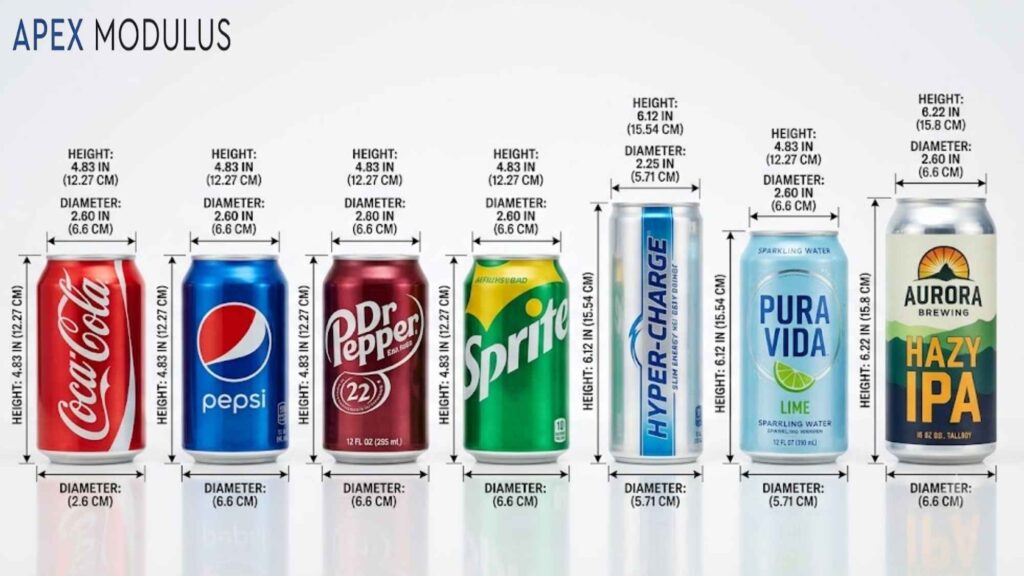
Here is the surprising part: Coca-Cola’s dimensions are not really “Coke” dimensions at all. They are industry-wide standards.
Pepsi, Dr Pepper, Sprite, and most domestic beers all use the identical 2.6-inch diameter and near-identical height for their standard 12 oz format. That is because beverage can dimensions got standardized decades ago so that manufacturers, canning plants, and retailers could all use the same equipment regardless of brand.
Where you do see differences is in specialty formats. Energy drinks lean toward slimmer 8.4 oz cans. Craft beer favors the 16 oz tallboy. Premium sparkling waters often choose the narrower slim-can profile purely for shelf presence. Coca-Cola’s core lineup, though? It sticks close to the industry benchmark.
Explore, How Long Is 10 Inches? 15 Everyday Objects
Practical Uses for Knowing Coke Can Measurements

This is not just trivia. These numbers come in handy more often than you would expect:
- 3D modeling and product design — accurate can dimensions matter for mockups, packaging design, and rendering realistic props.
- Shipping and storage planning — knowing exact height and diameter helps you calculate how many cans fit in a cooler, fridge shelf, or shipping box.
- DIY and repurposing projects — crafters building can-based projects need precise measurements to plan cuts and fittings.
- Vending and retail planning — businesses stocking machines or coolers need to know exact clearances.
A standard can needs roughly 5 inches of vertical clearance including spacing, while taller slim cans need closer to 6.5 inches. Small detail, but it changes how you plan a fridge shelf or a cooler pack.
Conclusion
Next time you crack open a Coke, you are holding more engineering than you would think. That familiar shape — the 2.6-inch grip, the tapered neck, the razor-thin aluminum wall holding back real pressure — represents decades of refinement aimed at one goal: making a can that is cheap to produce, easy to ship, comfortable to hold, and consistent no matter where in the world you buy it. Simple object, surprisingly deliberate design.
Related article, Pokémon Card Dimensions: The Complete Size Guide
Quick Quiz: How Well Do You Know Your Coke Can?
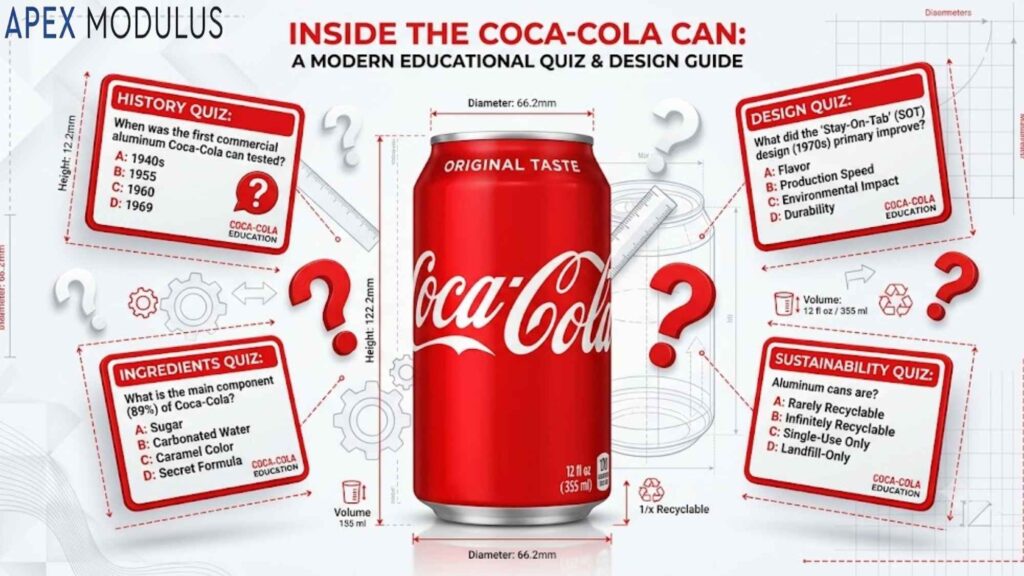
Before you go, test what you just picked up. Answers are hidden below each question — no peeking until you have made your guess.
1. How tall is a standard 12 oz Coke can?
A) 3.62 inches B) 4.83 inches C) 6.19 inches D) 5.11 inches
B) 4.83 inches — the standard can has held this exact height since the modern design locked in during the 1980s.
2. What is the body diameter shared by nearly every Coke can format?
A) 2.13 inches B) 2.60 inches C) 3.00 inches D) 1.90 inches <details> <summary>Reveal answer</summary>
B) 2.60 inches — this width stays constant across mini, standard, and tallboy cans. Only the height changes between formats.
3. What does the industry call the 2.13-inch lid opening on a standard can?
A) A 202 end B) A neck seal C) A crown cap D) A drawn cup
A) A 202 end — shorthand for 2 and 2/16ths of an inch, the standard terminology across the entire beverage can industry.
4. Which country uses the 375ml can as its national standard?
A) United Kingdom B) Japan C) Australia D) Canada
C) Australia — the 375ml can stands about 5.11 inches tall, sitting between the US mini and standard sizes.
5. Roughly how thin is the aluminum wall of a Coke can?
A) 0.0037 inches B) 0.05 inches C) 0.5 inches D) 0.15 inches
A) 0.0037 inches — thinner than a human hair, yet strong enough to hold over 90 PSI of carbonation pressure.
Frequently asked Questions
How much does an empty Soda can weigh?
An empty standard 12 oz Coke can weighs about 0.5 ounces (14 grams) — light enough that a full case of 24 adds barely a pound in packaging weight.
How many times can a Coke can be recycled?
Aluminum cans can be recycled indefinitely without losing quality, and a recycled can typically returns to store shelves as a new can within 60 days.
How big is the opening on a Coke can’s pull tab?
The drinking opening measures roughly 0.5 inches across — small enough to control the pour rate but wide enough to drink comfortably without tilting the can too far.
Also read, Monster Can Dimensions: Size Guide for Every Variant

I’m Amelia Brown, author for the Dimension Category at Apex Modulus. I research, write, and curate content focused on precise dimensional frameworks, measurement units, and structural guidelines to ensure our readers and team have accurate, actionable information.