

If you’ve ever tried to jam a Pokémon card into the wrong sleeve, you already know why dimensions matter more than most people think. Honestly, a few millimeters off, and your card either swims around loose or gets crushed at the edges. So, let’s settle this once and for all, with real numbers, not vague guesses.
This guide covers every official size, every unit of measurement, and the small details that separate a genuine trading card from a fake. Grab a ruler if you want to follow along. You would not need it, but it is a fun way to check your own collection as we go.
a standard Pokémon Card
A standard Pokémon TCG card measures 2.5 inches by 3.5 inches, which converts to 63.5mm by 88.9mm, or 6.35cm by 8.89cm. That’s it. That is the number you came here for.
But there is a lot more worth knowing, especially if you are buying sleeves, printing custom art, or trying to figure out whether that “rare” card your cousin traded you is legit.
Official Pokémon Card Dimensions
Width, Height, and Thickness
Every standard card in the Pokémon TCG, from a basic Energy card to a full-art secret rare, shares the exact same footprint. Rarity changes the finish. It doesn’t change the frame.
Here’s the full breakdown:
| Measurement | Value |
|---|---|
| Width | 2.5 in / 63.5mm / 6.35cm |
| Height | 3.5 in / 88.9mm / 8.89cm |
| Thickness | ~0.012 in / ~0.3mm |
| Weight | 1.7–2g (standard, non-holo) |
| Weight (holo/full-art) | 1.9–2.1g |
| Corner radius | ~0.125 in / ~3.18mm |
| Aspect ratio | 5:7 |
A holographic card weighs a hair more than a common because of the extra foil layer underneath the lamination. It’s a tiny difference, somewhere around 0.1 to 0.2 grams, but serious collectors sometimes use it as a rough clue when “pack weighing” unopened boosters. It’s not foolproof, though. Plenty of modern sets balance pack weight on purpose to stop exactly that trick.
Why Pokémon Cards Are This Size
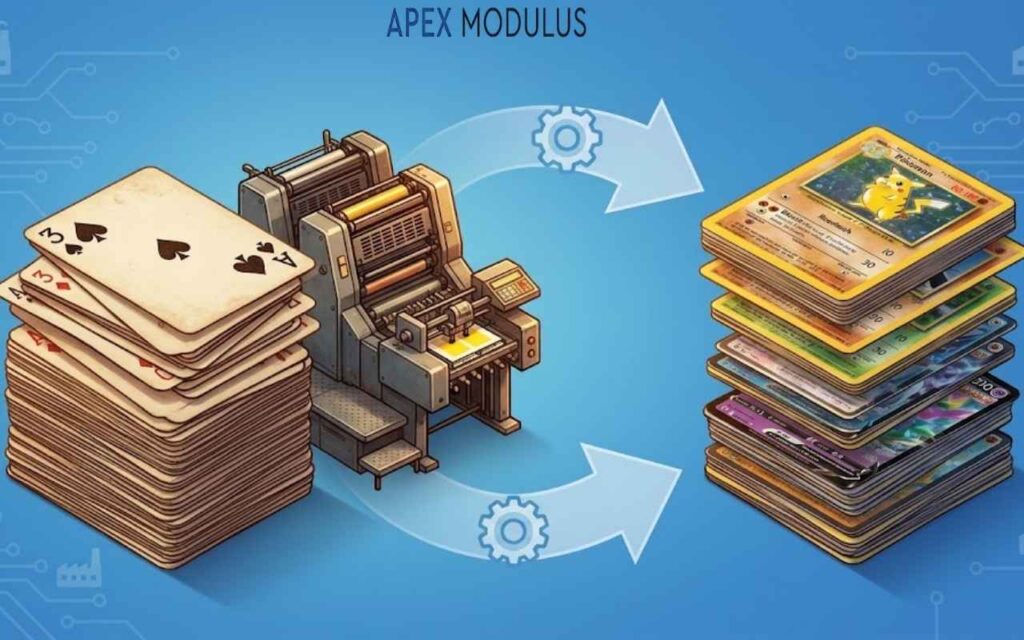
Here’s something most guides skip entirely: Pokémon did not invent this size. When the game launched in 1996, it borrowed the exact card dimensions already used for standard playing cards and poker decks. And that’s not a coincidence.
Because of that shared standard, manufacturing lines that print and cut playing cards could be repurposed for trading cards without retooling, which kept production costs down during the game’s early explosion in popularity.
That’s also why a standard Pokémon card slides into the same sleeves, binders, and card presses used for Magic: The Gathering, baseball cards, and dozens of other trading card games.One factory standard, shared across an entire industry.
Pokémon Card Sizes in Every Unit
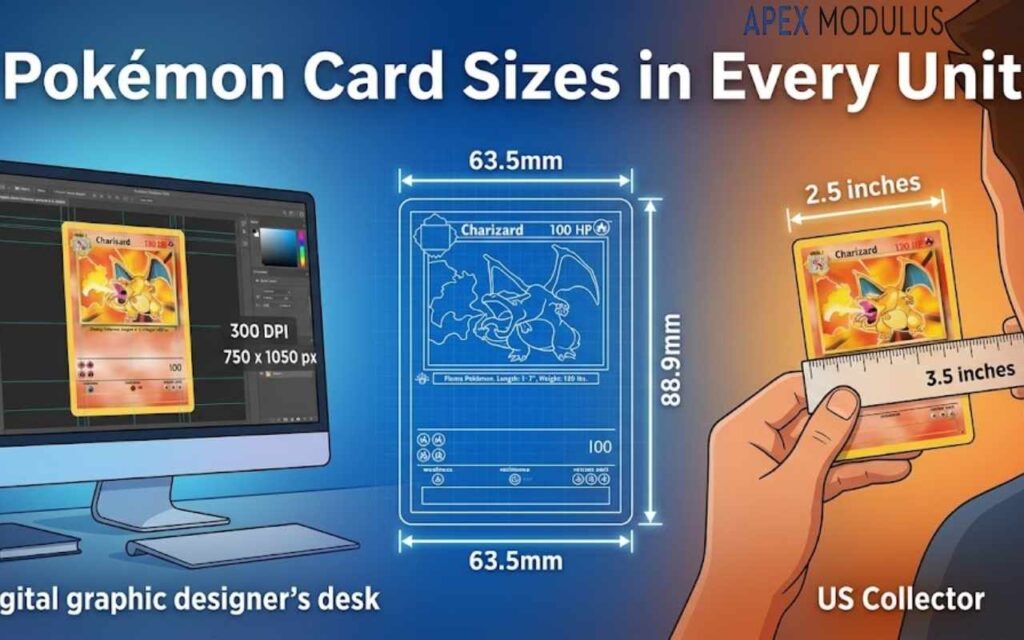
Different tasks call for different units. A European sleeve manufacturer works in millimeters. A US collector thinks in inches. A graphic designer building custom card art needs pixels. Here’s everything side by side, so you never have to convert on the fly again.
Inches, Centimeters, and Millimeters
| Unit | Width | Height |
|---|---|---|
| Inches | 2.5 in | 3.5 in |
| Centimeters | 6.35 cm | 8.89 cm |
| Millimeters | 63.5 mm | 88.9 mm |
Millimeters matter more than people realize once you get into grading. When PSA or Beckett evaluates a card’s centering, they are measuring in millimeters, not inches. A border that sits even 1mm off-center on one side can knock a card down a grade or two, which is a big deal when the difference between a PSA 9 and a PSA 10 might be hundreds of dollars.
Pixels for Digital Design and Printing
If you are building card artwork, setting up a digital canvas in Procreate, Photoshop, or Illustrator, or printing proxies at home, you need pixel measurements, not physical ones.
| Resolution | Width (px) | Height (px) | Best Used For |
|---|---|---|---|
| 72 DPI | 180 px | 252 px | Web previews, thumbnails |
| 150 DPI | 375 px | 525 px | Draft prints, low-quality proofs |
| 300 DPI | 750 px | 1050 px | Print-ready, professional quality |
300 DPI is the floor, not a suggestion. Anything lower and your printed card will look soft around the text and border, even if the physical size comes out correct. Take 72 DPI, for example: the dimensions are technically right, but the image quality falls apart the moment it’s off a screen.
So, if you’re setting up a Pokémon card dimensions for Procreate canvas specifically, build at 750 x 1050 px minimum. From there, bump your canvas to 825 x 1125 px if you’re including bleed for trimming.
Print Bleed Size
Speaking of bleed: never design artwork that stops exactly at the card’s edge. Trimming machines are not perfect, and a tiny shift during cutting can leave a sliver of white space along one edge if your art does not extend past the cut line.
Add a 0.125-inch bleed on all four sides. That brings your total canvas to 2.75 x 3.75 inches, or 825 x 1125 px at 300 DPI. Keep any critical text or logos at least 0.0625 inches inside the final trim line, just to be safe.
Every Pokémon Card Size and Format
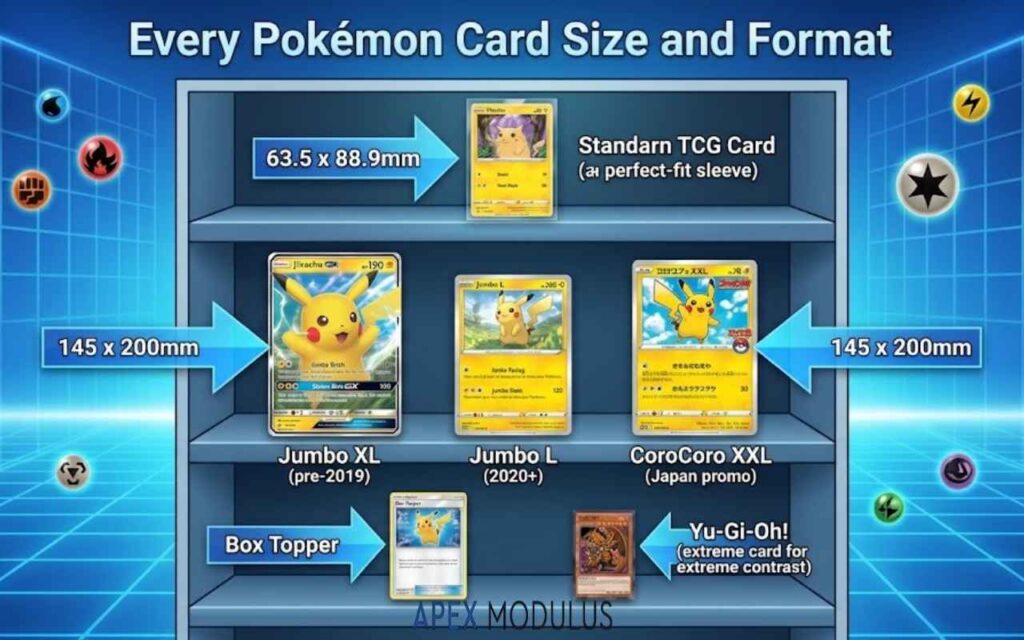
Not every card that’s ever shipped with the words “Pokémon” on it matches the standard size. Promotional cards, especially, go big.
Standard Card
This is the one that matters for actual gameplay. Standard TCG card size across every set, every era, and every language is 2.5 x 3.5 inches. No exceptions, no variants, no “special edition” cards that quietly changed size. If a card claiming to be tournament legal doesn’t match this size, something is wrong with it.
Jumbo Cards
Here’s where things get interesting, and where a lot of size guides get sloppy. Jumbo Pokémon cards aren’t one fixed size. The specs actually shifted over time.
| Jumbo Type | Dimensions (mm) | Dimensions (in) | Era |
|---|---|---|---|
| Jumbo XL (pre-2019) | 145mm x 200mm | 5.7 in x 7.9 in | 2000–2019 |
| Jumbo L (2020+) | 133mm x 185mm | 5.2 in x 7.3 in | 2020–present |
| Box Topper | 90mm x 126mm | 3.5 in x 5.0 in | Ongoing |
| CoroCoro XXL | 145mm x 205mm | 5.7 in x 8.1 in | Japan-exclusive promos |
Pokémon quietly downsized their jumbo promo format starting around 2020, shrinking it from the older XL spec to a slightly smaller L spec. If you’re shopping for jumbo card sleeves and your card was pulled from a tin before 2019, don’t assume the newer sleeve sizes will fit. Measure first.
None of these oversized formats are legal for constructed play in Pokémon TCG decks. They exist purely as display pieces, convention giveaways, or prize inserts. Think of them as posters with card stock instead of paper.
Japanese vs International Pokémon Cards
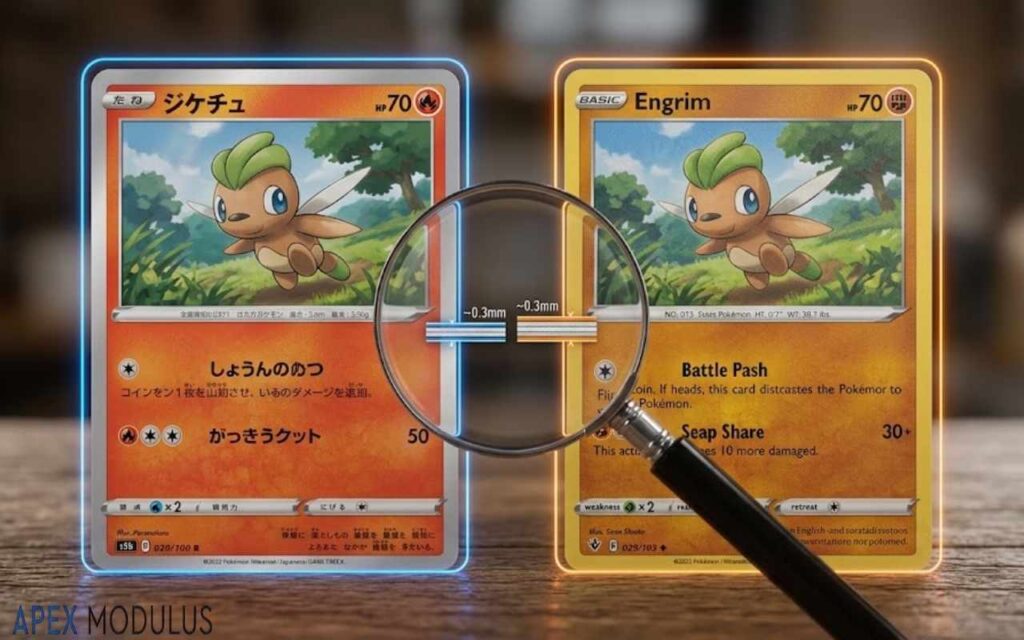
Here’s a persistent myth worth clearing up: Japanese Pokémon cards are not a different physical size than English Pokémon cards. Both follow the same 2.5 x 3.5 inch, 63.5 x 88.9mm standard.
“Rarity changes the finish, not the frame.” That holds true across languages too.
What actually differs between Japanese and international print runs isn’t size, it’s texture and stock:
- Cardstock thickness — Japanese cards often use a marginally thinner, snappier stock, which some players describe as feeling more like a playing card straight out of the box.
- Border finish — Japanese cards traditionally use a glossier coating on the front border compared to the matte-ish finish on many English cards.
- Corner cut — Some collectors report Japanese cards feeling slightly sharper at the corners, though this comes down to individual printing batches more than a fixed spec.
If your Japanese cards feel loose inside a sleeve built for English cards, it’s almost never a size mismatch. It’s the thickness difference. A card that’s a fraction of a millimeter thinner will always rattle a bit more in the same sleeve.
How Pokémon Cards Compare to Everyday Objects
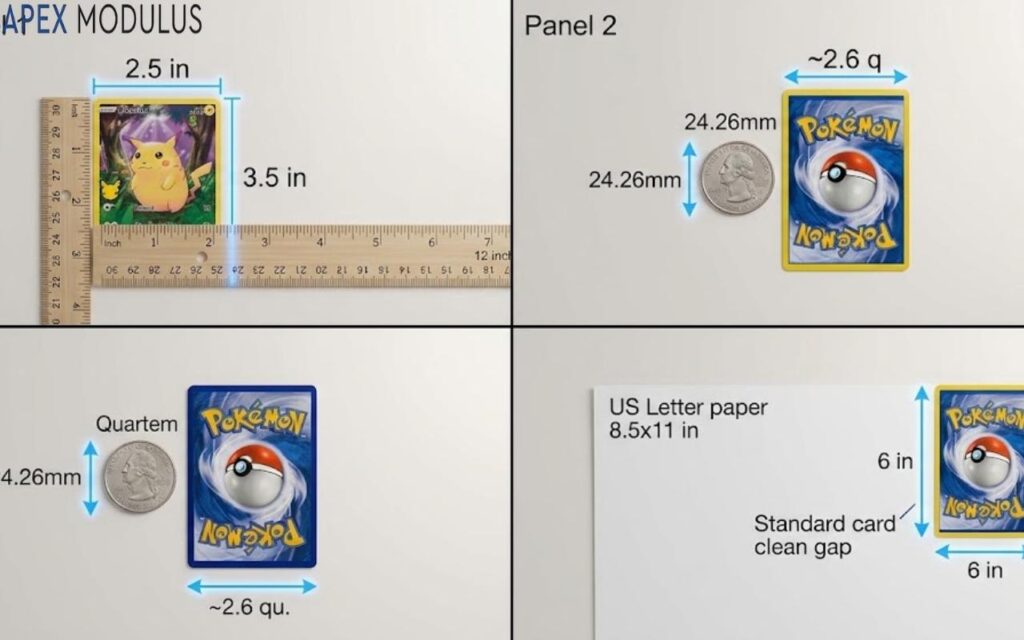
Numbers on a page don’t always click. Sometimes you just need something to hold up next to the card in your hand.
- A standard playing card — This is the closest match there is. A Pokémon card and a playing card from any standard poker deck share the exact same 2.5 x 3.5 inch footprint. If you’ve ever held a deck of cards, you already know exactly how a Pokémon card feels in hand.
- A credit card — A credit card measures 3.37 x 2.125 inches, noticeably shorter and narrower than a Pokémon card. Line them up and the Pokémon card sticks out on both the top and one side.
That’s really all you need for a mental size check. Skip the smartphone and sticky-note comparisons you’ll find elsewhere; they’re cute, but they don’t actually sharpen your sense of scale the way a playing card does, since almost everyone has held one.
How Pokémon Card Size Compares to Other TCGs
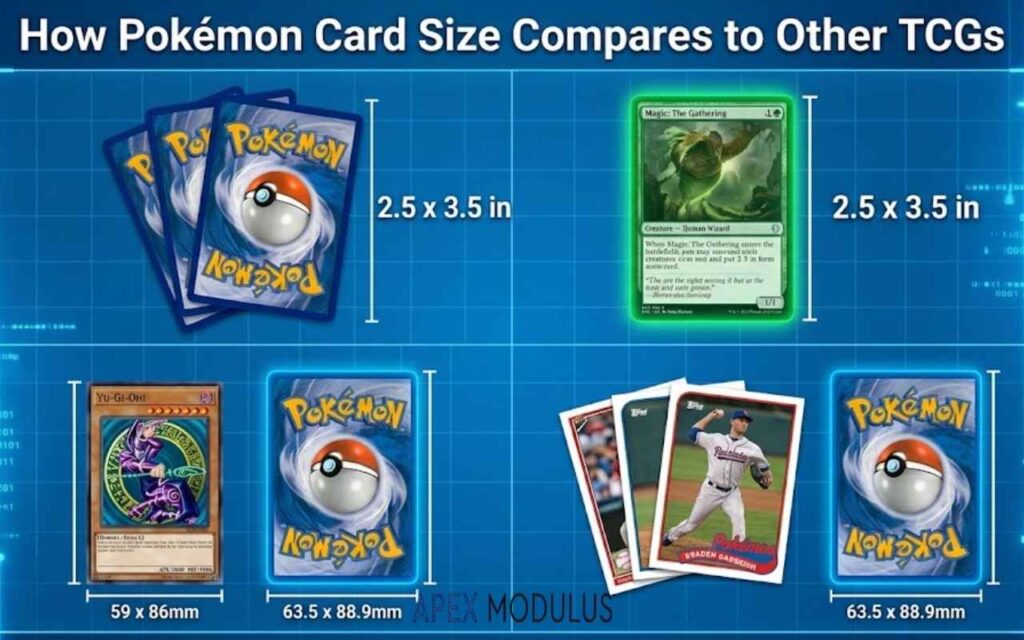
This is where the “standard” in standard card size earns its name. Pokémon isn’t an outlier. It’s part of an industry-wide agreement, whether formal or not.
| Trading Card Game | Card Size |
|---|---|
| Pokémon TCG | 2.5 x 3.5 in (63.5 x 88.9mm) |
| Magic: The Gathering | 2.5 x 3.5 in (63.5 x 88.9mm) |
| Yu-Gi-Oh! | 2.42 x 3.46 in (59 x 86mm) — slightly smaller |
| Standard sports cards (baseball, basketball) | 2.5 x 3.5 in (63.5 x 88.9mm) |
Notice Yu-Gi-Oh! breaks the pattern. Its cards run slightly smaller than the poker-card standard, which is why Yu-Gi-Oh! players need dedicated sleeves and can’t just borrow whatever’s left over from a Pokémon binder.
Why does this matter beyond trivia? If you collect across multiple franchises, this table tells you exactly which sleeves, binders, and toploaders can pull double duty and which ones you’ll need to buy separately.
Pokémon Card Sleeves, Toploaders, and Storage Sizing
Buying the wrong storage size is the single most common mistake new collectors make. Here’s how to avoid it.
Standard Sleeve Sizes
Card sleeves built for standard trading cards typically run a hair larger than the card itself, giving the card room to slide in without friction damaging the edges.
| Sleeve Type | Dimensions |
|---|---|
| Standard perfect-fit inner sleeve | 63mm x 88mm (snug) |
| Standard outer sleeve | 66–67mm x 91–92mm |
| Penny sleeve | 2.5 x 3.5 in (minimal clearance) |
| 3×4 sleeve | 3 in x 4 in (roomier, common for double-sleeving) |
Perfect fit sleeves are worth knowing about specifically. They’re cut so close to the actual card dimensions that they sit almost flush, with no rattle at all. Collectors typically layer a perfect-fit sleeve underneath a slightly looser outer sleeve, giving the card two layers of separation from the elements without adding any visible bulk.
Toploader Sizes
Toploaders are rigid, so their internal dimensions matter more precisely than sleeves.
| Toploader Type | Internal Size | Use Case |
|---|---|---|
| 35pt | 2.6 x 3.6 in | Single card, sleeve required |
| 3×4 | 3 x 4 in | Standard raw or single-sleeved card |
| Magnetic (35pt) | 2.6 x 3.6 in | Display and long-term storage |
| Graded slab holder | Varies by grading company | PSA, BGS, CGC slabs |
The “pt” number refers to thousandths of an inch of clearance, not the card’s own thickness. A 35pt toploader gives you enough room for a sleeved standard card without leaving so much slack that the card slides around and picks up edge wear.
Binder Page Sizing
Standard 9-pocket binder pages are built around the 2.5 x 3.5 inch standard and comfortably hold a sleeved card. If you’re storing Jumbo XL cards, though, you’ll need dedicated oversized pages, since a jumbo simply won’t fit a standard pocket no matter how you angle it.
Using Dimensions to Spot a Fake Pokémon Card
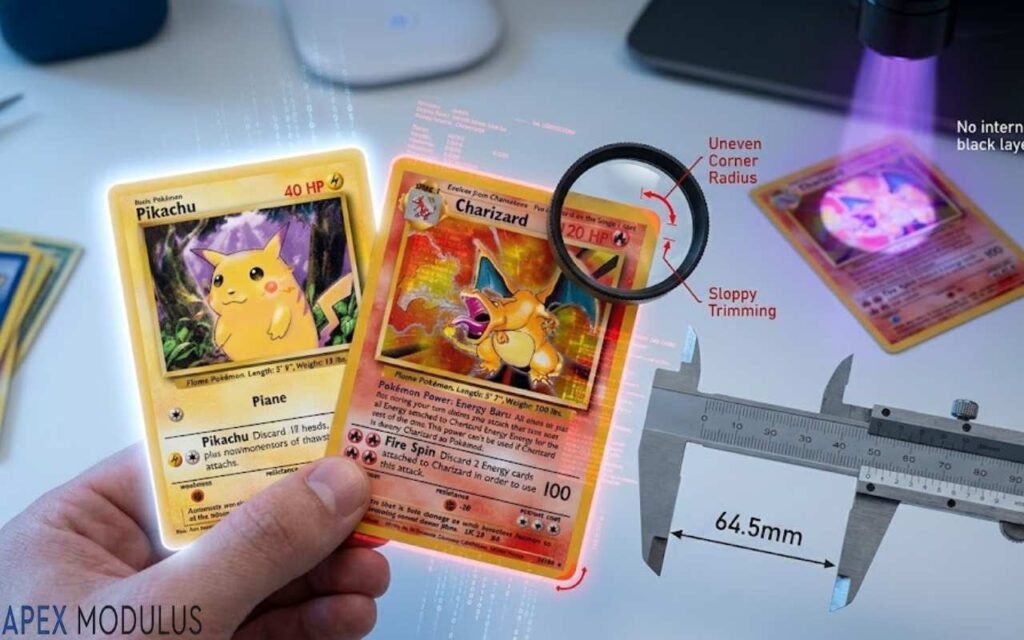
This is where knowing the exact numbers pays off in real money saved. Counterfeiters get the artwork close. They rarely get the measurements exactly right.
Width and Height Tolerance
A genuine card sits at 2.5 x 3.5 inches with almost no deviation, typically within a fraction of a millimeter across an entire print run. If a card measures noticeably off, even by a millimeter or two, treat that as a red flag. Lay a suspect card directly on top of one you know is authentic. Any visible overhang on one side is a bad sign.
Thickness and Card Stock Feel
Real Pokémon cards run about 0.012 inches, or roughly 0.3mm thick. Counterfeits frequently use whatever cardstock is on hand, which tends to run either noticeably thinner (feels flimsy, almost like paper) or thicker (feels stiff, doesn’t shuffle naturally). Fan a stack of known-genuine cards and feel how they flex. A fake often stands out immediately once you’ve handled the real thing.
Weight
A standard genuine card weighs between 1.7 and 2 grams. This sounds too small to matter, but a decent kitchen or jewelry scale will catch it. Counterfeits printed on heavier cardstock, or on cheap thin paper stock, will read noticeably off from that range. Weigh five or six cards from a suspect batch and average them. One outlier could just be a holo. A whole batch that’s consistently off points to a fake.
The Light Test
Hold a genuine card up to a bright light source. Authentic Pokémon cards have a black layer sandwiched between the front and back printing, which blocks light from passing through. Fakes, especially cheaply printed ones, often let light bleed straight through the card because they skip that internal layer entirely.
Corner Radius and Cut Quality
Genuine cards use a consistent corner radius of roughly 0.125 inches, giving each corner a smooth, uniform curve. Counterfeits cut on lower-quality equipment often show corners that are too sharp, too rounded, or uneven from corner to corner on the same card. Run your finger along the edge. A slightly rough or uneven feel is a warning sign worth paying attention to.
How to Measure a Pokémon Card at Home Without Calipers
You don’t need precision lab equipment to check a card’s size. Here are three methods that work with things you probably already own:
- The printer paper trick. Standard US letter paper is exactly 8.5 x 11 inches. Line a card up against the short edge, and a genuine card should take up almost exactly 2.5 inches, leaving a clean 6-inch gap to the paper’s edge.
- The ruler method. A basic ruler works fine here, just make sure you’re measuring from the true outer edge of the card, not from where the border design starts. Measure both the width and height, and check both against the 2.5 x 3.5 inch standard.
- The phone camera trick. Lay the card next to a coin of known size (a US quarter is 24.26mm across) and snap a photo directly overhead. You can then compare the card’s proportions to the coin using any basic photo-editing app’s ruler or grid tool.
None of these methods will catch a fake that’s off by half a millimeter. But they’ll absolutely catch the kind of sloppy counterfeit that’s off by three or four millimeters, which covers the vast majority of fakes circulating online.
Frequently Asked Questions
Do Pokémon cards shrink or warp over time?
Slightly, humidity can swell edges by a fraction of a millimeter; storing flat in a binder or box prevents it.
Is a first edition Pokémon card a different size than a reprint?
No, same 2.5 x 3.5 inch standard; only the stamp and print run differ, not the dimensions.
What size are Pokémon TCG playmats built for?
Roughly 24 x 14 inches, sized around the 7-card active board layout, not the card size itself.
Do oversized display cases fit both standard and jumbo cards?
Rarely the same case; jumbo cases run close to 6 x 8.5 inches internally, too large for a standard card to sit snug.
Are Pokémon Center exclusive cards a different size than retail cards?
No, identical 2.5 x 3.5 inch standard; exclusivity affects print run and packaging, not card dimensions.
The Bottom Line
Strip away the rarity, the foil, the price tag, and every Pokémon card comes back to the same number: 2.5 x 3.5 inches, 63.5 x 88.9mm. That single standard is why a 1999 Charizard and a 2026 pull share the same sleeve, the same binder page, and the same toploader without either one ever knowing the difference.
Knowing these numbers isn’t just trivia. It’s what lets you buy the right sleeves the first time, print custom art that actually fits, and spot a counterfeit before it costs you real money. The tools are simple: a ruler, a scale, maybe a bright light. The rest is just knowing what genuine looks like.
Measure twice. Trade once.
Pokémon Card Dimensions Quiz
Which test exposes a fake by exploiting its missing internal layer?
A. The weight test
B. The light test
C. The corner radius test
D. The sleeve-fit test
Answer: B — genuine cards have a black layer blocking light; cheap fakes let light bleed through.
What’s the exact size of a standard Pokémon card?
A. 2.5 x 3.5 inches
B. 2.75 x 3.75 inches
C. 2.42 x 3.46 inches
D. 3 x 4 inches
Answer: A — 2.5 x 3.5 in (63.5 x 88.9mm), true for every rarity since 1996.
How did Jumbo Pokémon card sizing change after 2019?
A. It got bigger, 133mm to 145mm
B. It got smaller, from Jumbo XL to a new Jumbo L spec
C. It didn’t change
D. It switched from inches to mm only
Answer: B — Jumbo XL (145 x 200mm) shrank to Jumbo L (133 x 185mm) starting 2020.
Which major TCG uses a noticeably smaller card than Pokémon?
A. Magic: The Gathering
B. Standard sports cards
C. Yu-Gi-Oh!
D. None, they’re all identical
Answer: C — Yu-Gi-Oh! runs 2.42 x 3.46 in, smaller than the 2.5 x 3.5 in standard.
What actually differs between Japanese and English Pokémon cards?
A. Japanese cards are physically smaller
B. English cards are physically smaller
C. Size is identical, cardstock and finish differ
D. No difference at all
Answer: C — same 2.5 x 3.5 in size; stock thickness and border finish are what change.

I’m Amelia Brown, author for the Dimension Category at Apex Modulus. I research, write, and curate content focused on precise dimensional frameworks, measurement units, and structural guidelines to ensure our readers and team have accurate, actionable information.