

Numbers on a page don’t mean much until you connect them to something you can picture. Someone tells you a building is 300 feet tall, and your brain just shrugs. Big? Small? Compared to what?
Below are ten real, fact-checked comparisons that show you what a 300-foot length actually looks like — plus a few popular “facts” that don’t hold up, quick ways to measure it yourself, and answers to the questions people ask most about this measurement.
How Long Is 300 Feet, Exactly?
| Unit | Value |
|---|---|
| Yards | 100 |
| Meters | 91.44 |
| Inches | 3,600 |
| Miles | 0.0568 |
300 feet equals 100 yards, or almost exactly 91.5 meters. At an average adult stride of 2.5 feet, walking it takes roughly 120 steps — a handy trick when you don’t have a tape measure.
It’s also a distance that shows up constantly without most people noticing. Sports fields, city blocks, and mid-rise buildings all cluster somewhere near this figure, which is part of why it makes such a useful benchmark: once you’ve internalized what 300 feet feels like, you start spotting it everywhere.
Learn more, How Long Is 7 Inches? 15 Everyday Objects.
What 300 Feet Looks Like in Real Life
Some objects land almost exactly on 300 feet. Others get close but miss by a wide margin. Here’s the honest breakdown of both.
1. An American Football Field, Goal Line to Goal Line
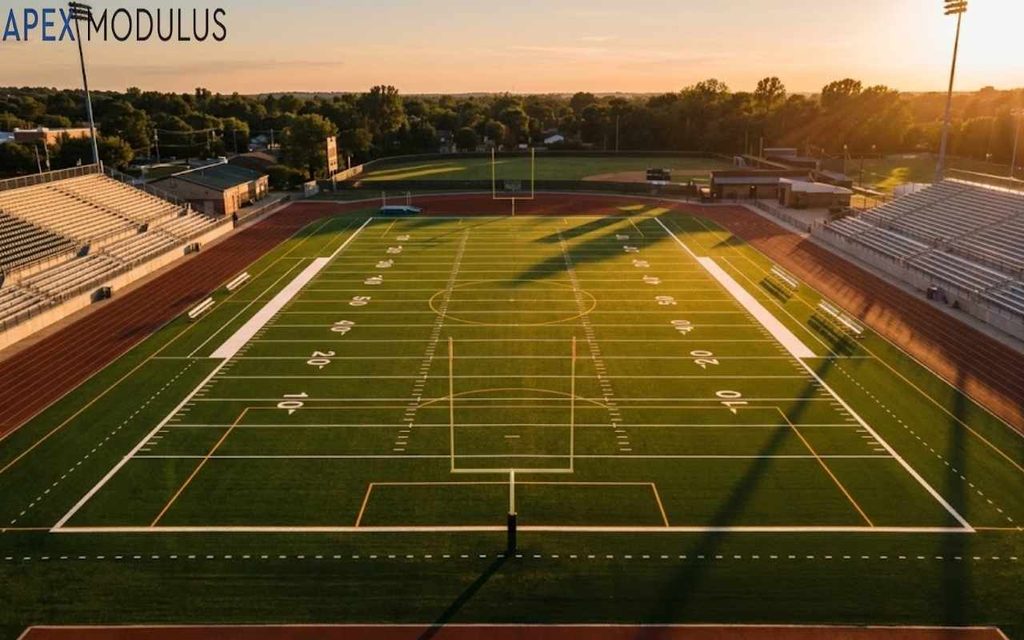
This is the cleanest match on the list. The American football field, used in the NFL, NCAA, and high school football, measures precisely 300 feet between the two goal lines — the 100-yard stretch where the actual gameplay happens.
The full football field, end zone to end zone, is 360 feet, since each end zone adds another 30 feet. So when people call a football field length “100 yards,” they usually mean the playing field, not the whole gridiron including both end zones. It’s the most reliable stand-in for 300 feet long you’ll find, no rounding required.
2. The Statue of Liberty, Ground to Torch

New York’s famous monument stands 305 feet 1 inch from the ground to the tip of her torch, just five feet past the mark. That total combines the copper statue (151 feet) with its 154-foot pedestal.
The Statue of Liberty works well as a mental anchor because most people already picture her scale from photos. Shave off a hair of her height and you’ve got 300 feet almost exactly — one of the closest matches among actual landmarks.
3. A Chicago City Block

A standard Chicago block runs about 330 feet, while a typical Manhattan cross-street block is only 264 feet — a difference rooted in how each city’s grid was laid out in the 1800s.
Both distances land close enough to 300 feet to give you a walkable sense of scale. Next time you’re downtown, count a block and see how it compares to your own estimate.
4. The Brooklyn Bridge Towers

The stone towers of the Brooklyn Bridge rise about 272 to 276 feet above the East River. They were the tallest structures in New York City when the bridge opened in 1883.
Other famous suspension bridges dwarf that figure — the Golden Gate Bridge‘s towers reach 746 feet, more than double. Bridge spans and tower heights vary enormously by era and by how much water they need to clear, which makes the Brooklyn Bridge one of the few famous examples that actually lands near 300 feet.
5. The General Sherman Tree

Sequoia National Park’s General Sherman Tree, the largest living tree on Earth by volume, stands 275 feet tall. It’s a giant sequoia (Sequoiadendron giganteum) — not the tallest tree in the world (coastal redwoods win that contest), but by far the bulkiest, with a trunk over 36 feet wide at the base.
It adds roughly the wood of an entire 60-foot tree to its trunk every year — and it’s still growing.
Among giant sequoia trees, its height is well documented and doesn’t shift much between sources, unlike some other tallest trees cited online.
6. The Antonov An-225’s Wingspan

Before it was destroyed in 2022 during the Russian invasion of Ukraine, the Antonov An-225 — nicknamed Mriya, “Dream” — was the world’s largest cargo aircraft. Its wingspan measured 290 feet, just 10 feet short of the mark, with an overall length near 275 feet.
Only one was ever built. It once carried entire diesel locomotives and, during the pandemic, tons of COVID-19 testing gear. No other aircraft in commercial or cargo aviation comes close to its scale — not even the Boeing 747-8 or Airbus A380.
Read more, Pokémon Card Dimensions: The Complete Size Guide
7. A Modern Wind Turbine’s Hub Height

Wind turbines have grown fast. In 2012, the average U.S. wind turbine stood about 280 feet at the hub. By 2023, that average hit roughly 339 feet — taller than the Statue of Liberty, according to the Department of Energy.
Somewhere in that climb, the typical wind farm turbine passed straight through 300 feet. And that’s before counting the blade tips: modern rotor diameters stretch over 430 feet across, so a turbine’s highest reach is far greater than its hub height alone suggests. Turbine tower height keeps rising because taller towers catch steadier wind.
8. Three NBA Basketball Courts, End to End

An NBA court measures 94 feet baseline to baseline. Three end to end come to 282 feet — not exact, but close enough for a solid mental image if you’ve spent time in a gym.
Basketball court dimensions are standardized league-wide, so this one holds steady no matter the arena. Getting to the full 300 feet takes about 3.2 courts.
9. A 25- to 30-Story Building

Here, the honest answer is “it depends.” Building height varies by floor-to-floor spacing, typically 10 to 13 feet once you include ceilings, framing, and mechanical space. A 30-story tower could run anywhere from 300 to nearly 400 feet.
Compact office towers tend to hit 300 feet closer to their 25th floor. A high-rise building with taller residential or hotel floors might hit that mark closer to floor 22 or 23. Treat this one as a range, not a fixed number.
10. Seven and a Half Shipping Containers

Standard ISO containers come in two lengths: 20 feet and 40 feet. Line up seven and a half of the 40-foot cargo containers end to end, and you land on exactly 300 feet — one of the most precise comparisons here, since shipping containers are built to strict international standards with zero ambiguity in the math.
Explore, How Long Is 10 Inches? 15 Everyday Objects
Popular “300-Foot” Comparisons That Don’t Hold Up

A few numbers that circulate online don’t survive a fact-check:
- Niagara Falls: The Horseshoe Falls, the largest of the three that make up Niagara Falls, drops only about 167 feet. The American Falls ranges 70 to 110 feet. Neither comes close to 300 feet in waterfall height.
- Blue whales: Adult blue whales run 70 to 100 feet long, with the largest recorded at 110 feet. Three lined up could land anywhere from 210 to 330 feet — too variable to call an exact whale length match, despite frequent claims otherwise.
- Mega cruise ships: Today’s biggest ocean liners blow past 300 feet entirely. The Icon of the Seas, the largest passenger vessel in the world, measures 1,198 feet — roughly four times the mark.
Quick Ways to Measure 300 Feet Without a Tape Measure

- Count your steps. An average stride covers about 2.5 feet, so roughly 120 steps gets you to 300 feet. Calibrate against a known football field first.
- Use floor tiles. Standard commercial tiles run 12 inches square, so counting 300 in a row (in a warehouse, say) gives a solid estimate.
- Picture a football field. Since the football field length between goal lines is exactly 300 feet, this is the fastest shortcut of all.
FAQs
Here are some frequently asked question:
Is 300 feet the same as a football field?
Only the part between the goal lines. The full field, including both end zones, is 360 feet — a distinction that trips a lot of people up.
What’s taller than 300 feet that people assume is shorter?
Modern wind turbines. Their hub height alone often exceeds 300 feet, and the blade tips reach even higher — most people underestimate just how large wind farm equipment has gotten.
What’s shorter than 300 feet that people assume is taller?
Niagara Falls. The Horseshoe Falls drop is only 167 feet, well under half of what many articles claim.
How many car lengths is 300 feet?
At roughly 15 feet per car, that’s about 20 cars nose to tail — a useful visual if you’re picturing traffic rather than landmarks.
Why do building comparisons for 300 feet vary so much?
Floor-to-floor height isn’t standardized. Offices, hotels, and residential towers all use different ceiling heights, so “300 feet” can mean anywhere from roughly 22 to 30 stories depending on the building type.
Is there anything that measures exactly 300 feet, with zero rounding?
Two things on this list: the football field’s playing surface (goal line to goal line) and seven and a half standard 40-foot shipping containers end to end.
How many football fields make up a mile?
About 17.6, using the 300-foot goal-line-to-goal-line measurement. A mile is 5,280 feet, so it takes just under 18 of these fields laid end to end to cover it.
Is a soccer pitch also 300 feet long?
Not quite. A FIFA World Cup pitch runs about 344 feet at the commonly used 105-meter length — noticeably longer than an American football field’s 300-foot playing surface, even though the two sports get compared constantly.
Wrapping It Up
300 feet stops being abstract once you’ve got real reference points. A football field‘s playing surface, the Statue of Liberty‘s height, and seven-and-a-half shipping containers all land on or near that mark — and now you know which popular comparisons, like Niagara Falls, don’t actually hold up.
The best comparison for you depends on what you already know well. Sports fans will reach for the football field or basketball courts; city dwellers might picture a block; frequent flyers might think of the An-225. Whichever one sticks, you’ll never look at a “300-foot” figure the same way again.
Discover, Monster Can Dimensions: Size Guide for Every Variant
Quick Quiz
Test yourselves to see if you got the concept of 300 feet right.
Which measurement is exactly 300 feet, with zero rounding?
a) The full football field, including both end zones
b) The football field’s playing surface, goal line to goal line
c) The Statue of Liberty, ground to torch
d) The Horseshoe Falls drop at Niagara Falls
Answer: b — The playing surface between goal lines is exactly 300 feet (100 yards). The full field with end zones is 360 feet.
How tall is the Statue of Liberty, from the ground to the tip of her torch?
a) 275 feet
b) 290 feet
c) 305 feet 1 inch
d) 339 feet
Answer: c — Just 5 feet over the 300-foot mark, combining her 151-foot statue with a 154-foot pedestal.
How many standard 40-foot shipping containers, end to end, add up to exactly 300 feet?
a) 5
b) 6
c) 7.5
d) 10
Answer: c — Seven and a half 40-foot ISO containers come out to exactly 300 feet.
Which popular “300-foot” claim actually falls way short in real life?
a) The Antonov An-225’s wingspan
b) The Horseshoe Falls at Niagara Falls
c) A modern wind turbine’s hub height
d) The General Sherman Tree
Answer: b — Horseshoe Falls only drops about 167 feet, well under half of 300 feet.
Roughly how many steps does it take an average adult to walk 300 feet?
a) About 50 steps
b) About 120 steps
c) About 250 steps
d) About 400 steps
Answer: b — At a stride of about 2.5 feet, 300 ÷ 2.5 ≈ 120 steps.
Related article, How Long Is 2 Inches? 15 Everyday Objects

Hi, I’m Emma Davis! As the Measurement Category Admin here at Apex Modulus, I oversee our standards, data integrity, and category guidelines to make sure everything stays accurate and seamlessly organized. Whether you need help navigating measurement specs or have questions about category standards, I’m here to keep things running smoothly.